Spain · Winter planning
Costa Blanca or Costa del Sol for a Winter Stay?
How Travel with Edit is funded: Read the disclosure.
Jump to the decision →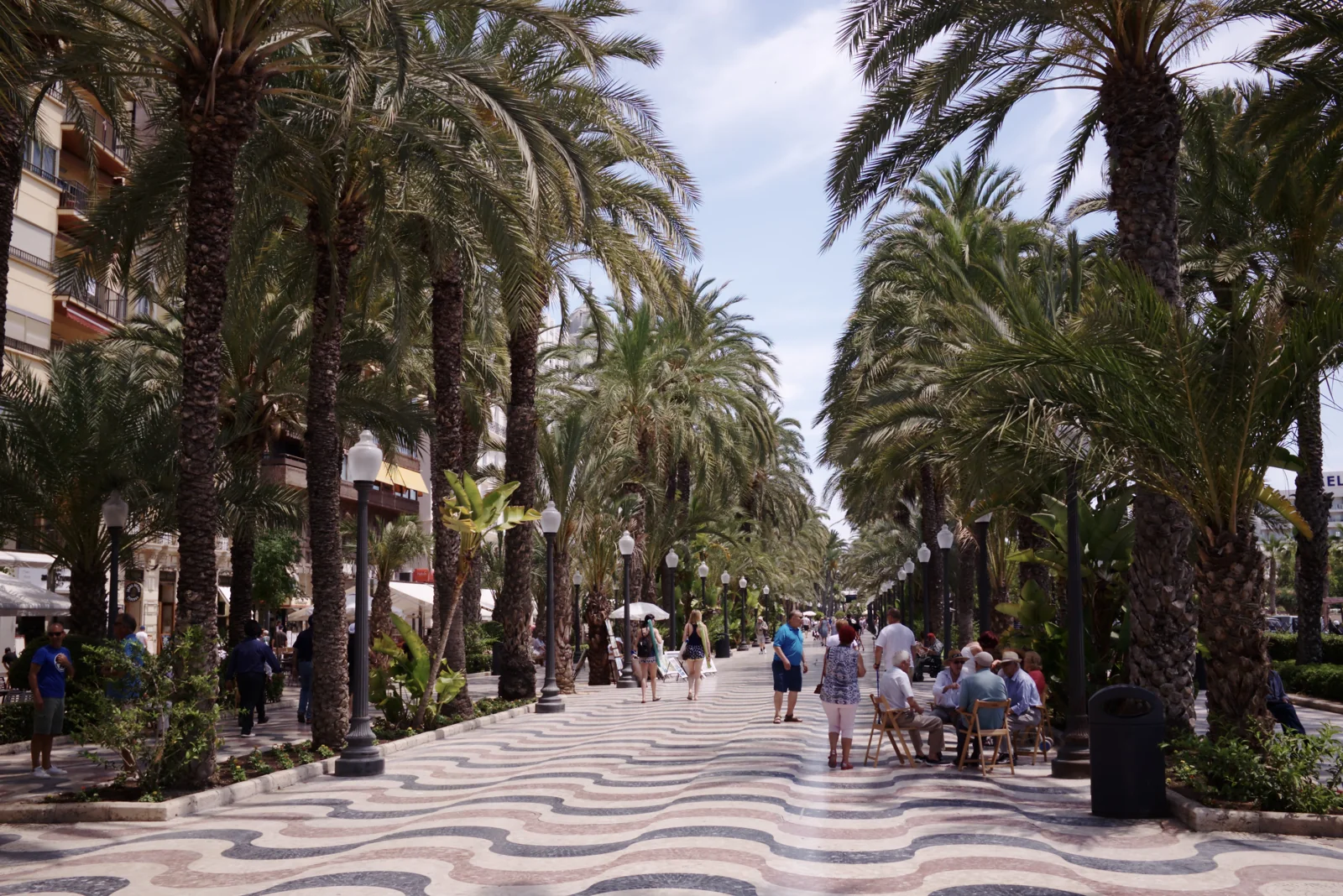
A sunny balcony is persuasive in an advert. It tells you very little about the flat at eight on a January evening, when you discover that the heating is poor and the nearest grocery shop means an uphill walk. That is why I would choose a Spanish winter base by town and street, not by a photograph of the sea.
For a first winter stay without a car, my initial shortlist would be central Alicante on the Costa Blanca and either Fuengirola or Málaga on the Costa del Sol. They are not the only possibilities. They simply make a fairer starting comparison than treating either entire coastline as one place.
First decide what you want an ordinary Tuesday to look like
If you want a city with markets, cafés, an urban seafront and coastal outings by tram, Alicante is a strong candidate. If a simple rail connection from Málaga Airport and an everyday seaside routine matter most, Fuengirola deserves an early look. Choose Málaga city when museums, food markets and city life matter more than living in a beach resort.
Benidorm and Torremolinos are worth keeping on the list if you enjoy a resort atmosphere. But look carefully at slopes between the building and the places you will use. Torrevieja, Marbella, Estepona and Nerja require their own transport plans; do not assume a train or tram serving a neighbouring town also serves them.
For an active traveller the ideal base may offer easy day trips. For someone who prefers gentler days, having groceries and an agreeable café close to home might be the more important luxury. Neither preference has much to do with a birthday.
How different is the January weather?
The useful starting point is Spain’s state meteorological agency, AEMET. Its 1981–2010 historical normals, not a forecast, give Alicante an average January daily maximum of 17.0°C and minimum of 6.3°C. At Málaga Airport the comparable figures are 16.8°C and 7.4°C. Those near-identical daytime figures make “the Costa del Sol is much warmer” a poor blanket claim.
AEMET’s January rainfall normals provide a sharper contrast: Alicante records about 23 mm over an average 3.6 days with at least 1 mm of rain; Málaga Airport about 69 mm over 5.8 such days. That does not mean you will get four wet days in Alicante and six in Málaga. Nor does airport weather describe every street or hillside on either coast. It tells you only what happened on average at those particular stations over a historical period.
The practical lesson: pack layers, expect cooler evenings and budget for heating. Both coasts still need rainy-day options. A house that feels cold and damp can spoil a stay even if the afternoon outside is lovely. Read Alicante’s AEMET station data and Málaga Airport’s data.
Alicante: a straightforward trial without a car
Alicante–Elche Airport is connected to Alicante city by the C6 bus. According to airport operator Aena, it stops at several city locations, including points connecting to the TRAM d’Alacant, such as Luceros. There is no coastal tram boarding directly at the airport. With luggage, the bus-to-tram transfer is a genuine extra step rather than a detail to ignore.
If a flat near the Luceros / central shopping area is on your shortlist, here is a realistic half-day test. Begin at Luceros, then identify the Central Market and the route towards the Explanada by the port. Visit just one of them first; rest at a café; return by the route you would actually use from your flat. That tells you far more about your everyday comfort than a full sightseeing itinerary.
For a more active day, use the TRAM network for a coastal excursion after you have checked the line, stops and return service for your dates. The tram offers useful links towards places such as Benidorm; the network does not make every Costa Blanca town rail-connected. A flat with a pleasant route to the tram is more useful than one advertised vaguely as “near Alicante”.
A rainy-day alternative is a market visit and a café close to home. Before moving in, check opening days, nearby toilets and whether there is somewhere sheltered to wait for transport. Benidorm or Altea can be attractive bases too, but they deserve individual checks for their hillier sections.
Fuengirola: the railway is the practical advantage
Málaga Airport has a station on the C1 Cercanías line between Málaga Centro Alameda and Fuengirola. Airport operator Aena gives indicative station-to-station journeys of around 12 minutes to Málaga centre and 34 minutes to Fuengirola. Neither figure includes your time finding the station, waiting for a train or getting from the destination station to the apartment door. Aena’s rail information should be checked before you travel.
Fuengirola station is at Paseo Jesús Santos Rein, 5. To test whether the central area suits you, plan a modest circuit from the station area towards Plaza de la Constitución and, if comfortable, the seafront. Choose one stop for coffee. Then try getting back to the station or to a possible flat without following an over-ambitious route. This is a suggested scouting circuit, not a claim that every crossing is level or every toilet is open. Confirm the final path on current maps and on site.
The active version is an easy-to-plan train outing along the C1 corridor once you know your nearest station. A gentler day might be little more than shopping, reading by the sea and lunch in the same neighbourhood. Either is a perfectly good reason to spend several weeks here.
Málaga city is another sensible candidate if you enjoy urban culture. With a central flat, markets and museums are part of everyday life; the trade-off is a busier city environment. If the coast itself matters more than urban attractions, Fuengirola may be a better first property search.
What about Torrevieja, Marbella, Estepona or Nerja?
They are not disqualified. But Torrevieja is not a TRAM d’Alacant stop, and Marbella, Estepona and Nerja are not stops on the Málaga–Fuengirola C1 railway. A flat in one of those places might still be excellent — provided you know how to get from the airport to the address, where you will shop and what happens if a bus stops running before your evening ends.
If two people disagree about whether the better holiday is by the beach or in a city, shortlist one property in each sort of place. Compare the real front-door routes rather than debating the coastline in general.
Five questions for a winter landlord
- Heating: What heats the bedroom and living room? Is electricity included, capped or metered? Ask for the relevant terms in writing.
- Damp and draughts: Are there current photographs of the windows and bathroom? Is there a history of condensation, and how is it managed?
- Access: Does the lift start at street level? Are there steps from the drop-off point, and can you see them on a recent video?
- Everyday location: Which supermarket or food shop and pharmacy can you reach on a comfortable route? Is there a café or other place to sit?
- Full cost and booking terms: Heating, cleaning, Wi-Fi, any applicable charges, deposit, cancellation, and the precise number of permitted nights.
The brightest south-facing balcony is still of limited use if you cannot sleep comfortably in a cold bedroom. Ask about the actual flat, not the building in general.
What the budget might reveal
A meaningful comparison needs the same winter dates, similar flat size, comparable amenities and the same number of nights. City-wide rental averages from different years are no substitute. Add total rent, likely heating, other utilities and realistic local transport. Keep refundable deposits visible as cash you need available, but not as a permanent expense.
Use two written quotations for your exact dates and address. For each one, record rent, electricity or heating, other utilities, cleaning, local transport and any non-refundable booking charges. Keep a refundable deposit in a separate “cash needed before arrival” line; include it in the cost only if the terms say it will not be returned. Then compare the same number of nights and the same assumptions. The total for each address is:
Rent + utilities + cleaning and non-refundable fees + planned local transport.
This calculation only compares the items you have entered. It does not establish which coast is generally cheaper, and it will change if a host changes the quote, your travel dates or your daily routine. If either host will not confirm an item in writing, mark it “unknown” and keep a separate contingency instead of filling the gap with a guessed price.
Next add groceries, meals out, insurance, return flights or trains, cleaning fees and a contingency allowance. Ask hosts whether a rate described as “monthly” applies to your actual arrival day and length of stay. A 30-night quotation and a six-week contract may have different conditions.
A good first week has space in it
I would allow one day after arrival for the supermarket, a simple meal and learning how to get home. The next day might be a short seafront outing. The day after that, perhaps a tram or train journey. There is no need to fill all seven days with attractions before you have worked out which shoes, jacket and pace suit the weather.
For an easier version, pick one nearby outing and a café with a toilet you have checked. For a fuller day, use the train or tram, but look up the last suitable return service and a taxi alternative before leaving. Wind, rain and an unexpectedly cold evening are easier to manage when you are not committed to a long walk home.
Entry and length-of-stay rules for winter 2026–27
For EU citizens, stays in another EU country are generally possible for up to three months without registering as a resident, although national formalities may apply; longer stays can require registration and supporting conditions. For many non-EU visitors, the Schengen short-stay limit is 90 days in any 180-day period, depending on nationality and status. These rules are not interchangeable: check the official advice that applies to you.
The EU Entry/Exit System (EES) has been fully operational at relevant external border points since 10 April 2026 for travellers within its scope. The separate ETIAS system is currently not in operation and is not collecting applications, according to the European Commission’s Smart Borders page, checked on 1 November 2026. Check the European Commission’s current EES and ETIAS status nearer departure, because implementation can change. Neither system is a substitute for a residence permit or permission to stay beyond the applicable limit.
Which coast makes the better first shortlist?
If your priority is a lively city and an interesting tram-based coastal outing, I would put central Alicante first. If your priority is a simple airport-to-train connection and a walkable seaside town, I would inspect central Fuengirola first. If you want galleries, food markets and an active city, give Málaga a serious look. A resort preference might lead you elsewhere, but then investigate local slopes and the airport transfer separately.
My final test would not be “Which coast has prettier sunshine?” I would ask the two hosts for the same details, then pick the flat that is warm at night and makes ordinary errands easy. If the cheapest flat needs a taxi for every short outing, that matters more than a clever booking-site discount.
Continue planning the right part of Spain
Climate and local transport details last checked: 20 October 2026. EES/ETIAS status rechecked against the European Commission on 1 November 2026. Climate averages are historical; live transport, prices, accommodation rules and immigration requirements need checking again for your dates.
Sources for climate, transport and entry rules
AEMET – Alicante historic climate normals