Yemen · Conservation, not travel advice
Socotra: The Island Where Trees Look Like They Belong on Another Planet
Discover Socotra’s extraordinary trees and biodiversity, conservation questions and official warnings against travel.
No commissioned booking links in this feature. Prices, opening hours, access and official travel advice can change. Check the linked sources for your dates. About recommendations.
TRAVEL SAFETY — NOT A TRIP RECOMMENDATION
Socotra is part of Yemen. As of 13 November 2026, the UK FCDO advises against all travel to Yemen, while Canada explicitly includes Socotra in its avoid-all-travel warning. This is a nature and conservation article, not a trip recommendation or booking guide. Official warnings can change: check the live advice for your nationality before making any travel decision. The US State Department also explicitly advises against travel to Socotra and warns about unofficial visas.
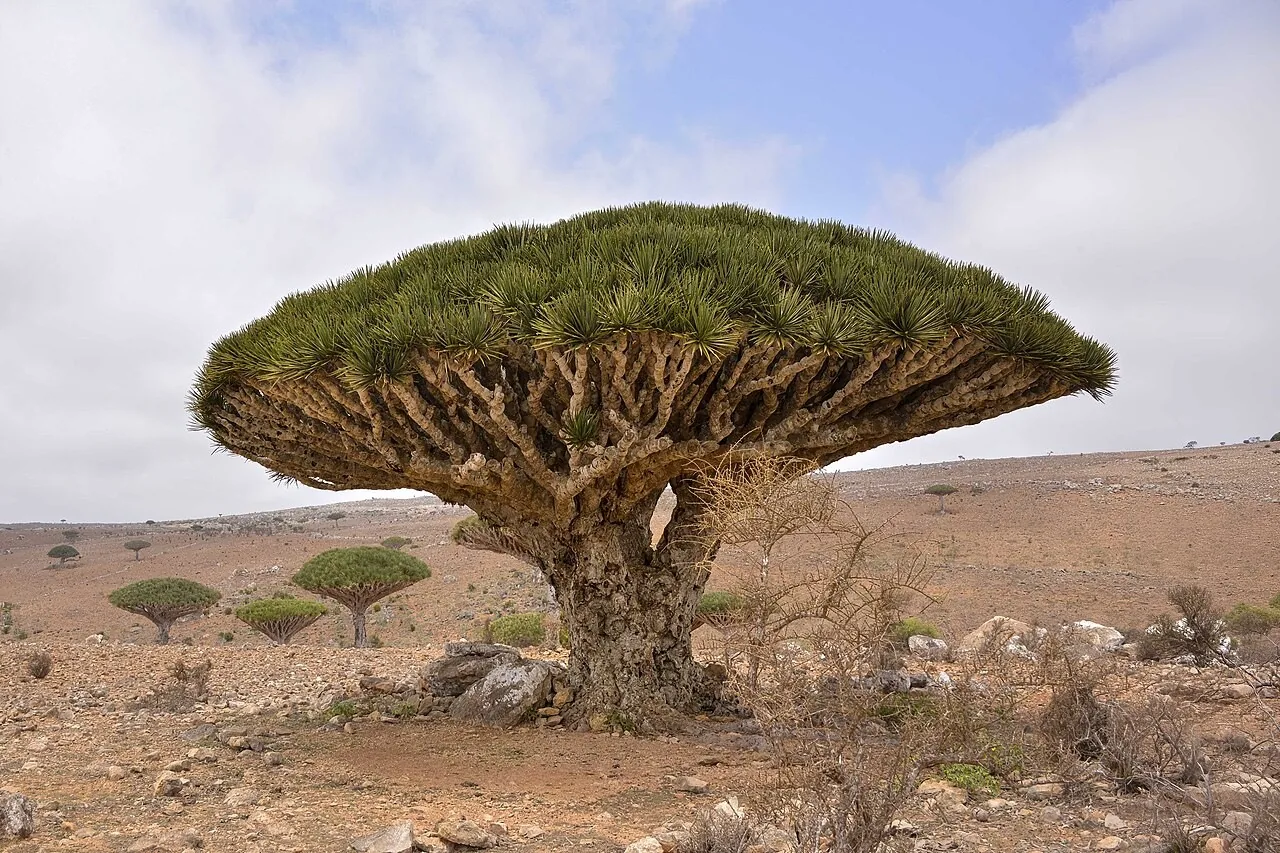
On Socotra, dragon's blood trees spread their branches into broad, umbrella-like crowns above the rocky ground. Their shapes seem almost invented. Yet the more astonishing story is real: isolation and adaptation have given this archipelago an exceptional variety of life found nowhere else.
An island of endemic life
Socotra belongs to Yemen and lies near the Gulf of Aden. UNESCO's World Heritage assessment documented 307 endemic plants among 825 recorded plant species, reflecting an unusually high concentration of species found nowhere else. These are historical assessment figures, not a live census.
Dragon's blood trees
The dragon's blood tree, Dracaena cinnabari, is known for its dense crown and red resin, long used for colouring and in traditional practices. Its shape is unmistakable, but there is no need to invent a neat, single explanation for why it grows that way.
More than one unusual tree
The dragon's blood tree is only the beginning. The Socotran desert rose and many other plants have adapted to very different surroundings, from mountains and plateaus to dry valleys and coastal habitats. The island is far more varied than the word 'desert' suggests.
Why conservation is urgent
Endemic species have nowhere else to fall back on. If their habitat is badly damaged, their future may be threatened across their entire natural range. Grazing, habitat degradation and changes in climate can also prevent young trees from taking hold. Saving mature specimens is only part of the work.
What the 2026 UNESCO review actually found
In Decision 48 COM 7B.68 (2026), the World Heritage Committee reported findings from a joint UNESCO–IUCN monitoring mission in 2025. The archipelago still retains the exceptional biodiversity for which it was listed, but important land and marine ecosystems are deteriorating. The Committee identified combined pressures from development, invasive species, pollution, climate change and unsustainable resource use. It also warned that protection and management remain insufficient. This is a conservation assessment, not a claim that every habitat has already been lost.
Two things can be true at once: Socotra remains exceptionally rich in unique wildlife, and some of its ecosystems are under serious pressure. A striking photograph tells you little about those pressures. Look beyond the famous trees to the island's residents, marine habitats and conservation challenges.
Local communities matter
Socotra is inhabited. Conservation must include the knowledge and livelihoods of its residents. Community-led nurseries and habitat-restoration projects described by the United Nations Environment Programme illustrate that protection is long-term work, not simply a matter of planting a few trees.
An archipelago, not a photo opportunity
The less photographed wildlife is just as extraordinary. UNESCO's inscription assessment reported that about 90% of the archipelago's reptile species and 95% of its land-snail species occurred nowhere else. Those historical figures are not a present-day census, but they show why protecting one photogenic tree cannot be the whole conservation strategy.
What a beautiful photograph cannot prove
A photograph captures the dramatic crown of a dragon's blood tree. It cannot show whether seedlings are surviving nearby, how the surrounding habitat is faring or who looks after the land. Captions should identify what is actually pictured, not call the island empty, untouched or safe for tourists. For the larger story, turn to conservation reporting.
Try reading three pictures as evidence rather than postcards: a mature dragon’s blood tree shows what survived; a seedling, if the image is reliably dated and located, offers a clue about regeneration; a landscape photograph gives context for the habitat. None proves the health of the whole ecosystem on its own. That is why the monitoring reports matter more than the most dramatic image.
Three claims worth checking before sharing
Three popular claims deserve a second look. 'Every plant is unique' exaggerates the evidence: high endemism does not mean every species is endemic. 'Nobody lives there' erases Socotra's resident communities. And 'tours are advertised, so it must be safe' confuses a commercial offer with official security advice. Those distinctions matter when an image is shared without the conservation or safety context.
How to evaluate a conservation appeal
Before donating or sharing a fundraising link, look for the organisation’s legal identity, named local partners, a description of what the money funds, recent activity reports and a transparent way to contact the team. A picture of a nursery is not proof of long-term survival: ask whether the programme reports follow-up monitoring, grazing protection or seedling outcomes. If those details are missing, do not treat the appeal as verified.
Should you visit?
Travel with Edit does not recommend booking a trip to Socotra. As rechecked against the UK and Australian government advisories on 13 November 2026 (with the US advisory reviewed on 13 November 2026), the UK FCDO advises against all travel to Yemen, and both Australian Smartraveller and the US State Department explicitly say not to travel to Socotra. Tour advertisements do not override official security warnings. The US State Department also warns that some operators have offered unofficial or invalid visas. This article deliberately provides no itinerary, booking links or travel-sales recommendations for the island.
A 15-minute armchair field guide
You can discover a great deal about Socotra without travelling there. Start with UNESCO's account of its unusual plants and animals, then read UNEP's reporting on conservation work involving local communities. Finally, consult the latest dated government travel advice to understand why this is an armchair journey for now. These sources offer a fuller picture than a collection of extraordinary tree photographs.
What the evidence can and cannot tell us
Biodiversity percentages cited here derive from historical UNESCO assessments, not a current census. Safety information was reviewed against UK and Australian government sources on 13 November 2026 and the US advisory on 13 November 2026; it may change without notice. Consult the live official pages before relying on any travel information. The image credit and licence are provided with the photograph.
Evidence and official safety advice
UNESCO: https://whc.unesco.org/en/list/1263/
UNESCO World Heritage Committee, 2026 decision (48 COM 7B.68): https://whc.unesco.org/en/decisions/9107/
UN Environment Programme: https://www.unep.org/en/news-and-stories/story/yemen-protecting-socotras-dwindling-biodiversity
UK travel advice: https://www.gov.uk/foreign-travel-advice/yemen
Australian travel advice: https://www.smartraveller.gov.au/destinations/middle-east/yemen
US Department of State travel advisory: https://travel.state.gov/en/international-travel/travel-advisories/yemen.html