Thailand · Arrival planning
Your First 24 Hours in Thailand: A Calm, Practical Arrival Guide
From Bangkok airport to your first night's sleep: transfers, mobile data, luggage, cash and three arrival plans that make the first day easier.
Affiliate disclosure: This article contains affiliate links. If you book or buy through one, Travel with Edit may earn a commission at no additional cost to you. Recommendations are based on their usefulness, not the commission offered. Read the disclosure.
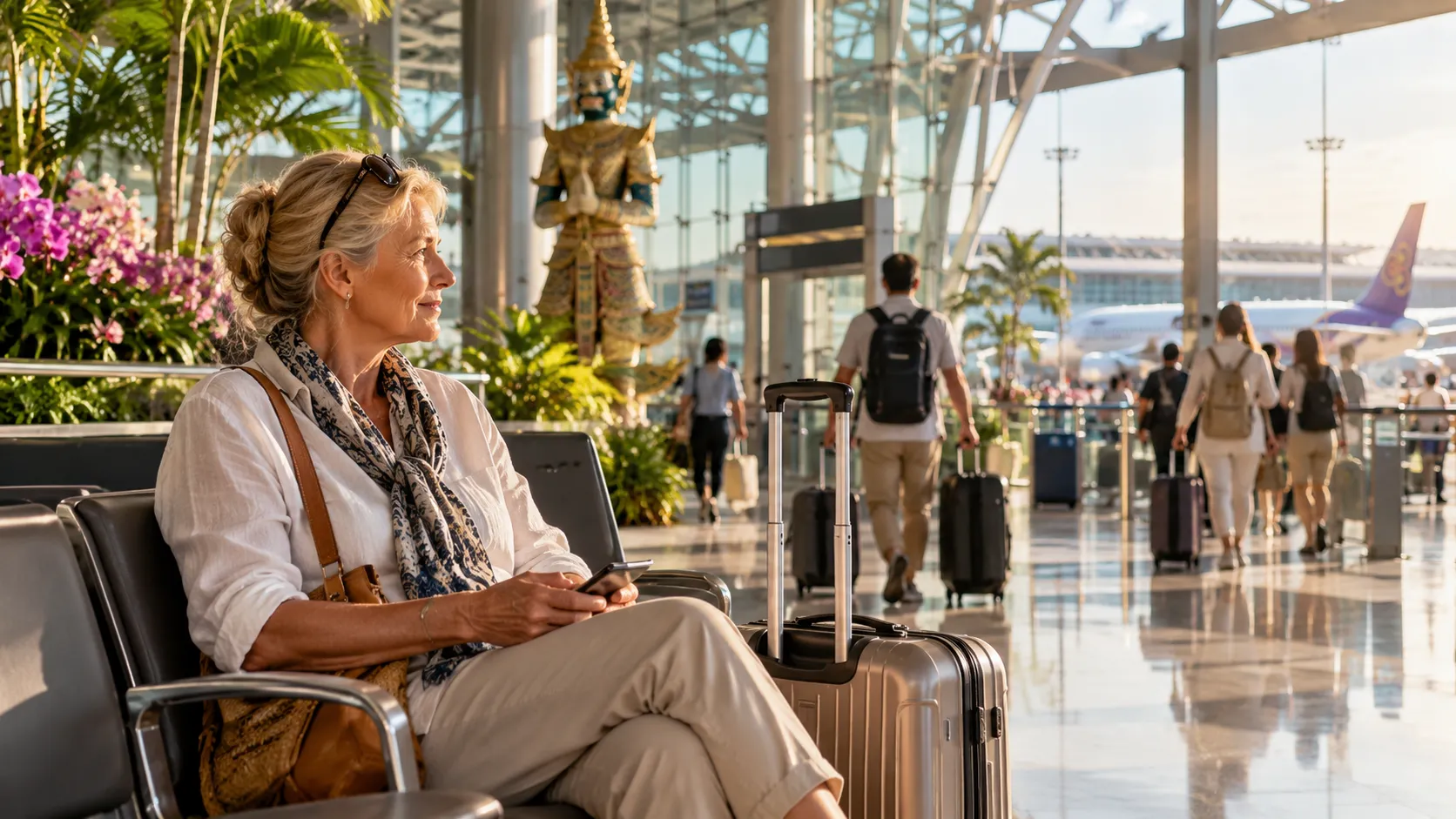
The flight has landed. You have collected your suitcase and reached the arrivals hall. Now comes a surprisingly important decision: what should you do next?
Perhaps your hotel room will not be ready for another five hours. Perhaps you are continuing to Jomtien, or your flight arrived late and the last thing you want is to work out an unfamiliar public transport system.
A long flight is tiring enough. Sort out your arrival address, onward journey and first night in advance, and you will have fewer decisions to make with your suitcase in hand.
This guide is for independent travellers who want a comfortable start, whether they are spending two weeks exploring Thailand or staying for several months over winter.
The three arrival plans below cover early check-in gaps, late landings and onward journeys, with a fallback for each.
Before departure: make five decisions while you are still at home
You do not need a minute-by-minute itinerary. These five checks cover the choices most likely to matter as soon as you land.
Know which airport you are using. Bangkok has two major airports: Suvarnabhumi (BKK) and Don Mueang (DMK). Check your actual ticket, not simply the word "Bangkok" on your booking.
Save your complete hotel address. Include the property name, district, telephone number and address in Thai if your accommodation provides it. Keep a screenshot so that you can show a driver even without internet.
Check the room's arrival arrangements. An early flight does not guarantee early check-in. Ask about luggage storage, reception hours and whether late arrival needs advance notice.
Plan the final part of your journey. A station may look close to your hotel on a map, yet involve an inconvenient walk with luggage. Consider the whole route from arrivals to your room.
Keep essentials in your hand luggage. This includes any regular medication, documents, phone charger, glasses, one change of clothes and whatever you would need if your checked suitcase were delayed.
Thailand's Digital Arrival Card: do not pay for it
Most non-Thai nationals entering Thailand must complete the Thailand Digital Arrival Card (TDAC). It is required for visa-exempt visitors too, subject to specified exceptions such as travellers remaining in transit without passing immigration.
The TDAC is free and should be completed within the three days before arrival, including the arrival date. It is not a visa and does not extend your permitted stay.
Use the official Thai Immigration TDAC website. Save the confirmation so you can retrieve it during your journey.
Visa rules depend on your nationality and circumstances. Thailand revised its visa-exemption categories on 15 September 2026, so do not assume that an older guide's stay limit still applies. Check the Royal Thai Embassy's current eligibility list for your passport and travel purpose; the TDAC is not permission to enter or remain in Thailand.
Arriving at Suvarnabhumi Airport (BKK): what happens next?
Once you have completed immigration and collected your suitcase, decide whether public transport or a road transfer will work better for your destination.
Airport Rail Link
Suvarnabhumi's Airport Rail Link station is on Level B1 of the main terminal. The airport currently lists operating hours of 05:30 to midnight.
This can be a sensible option if your hotel is near a convenient station or connection and you are happy to manage your luggage.
Before choosing it, look beyond the rail journey. Check how many changes are involved, whether your final station has the lift access you need and how far you must walk to your accommodation.
See the official Suvarnabhumi transport information for transport locations and updated services.
Official airport taxi
At Suvarnabhumi, official public taxis use the Level 1 service area between Gates 4 and 7. Follow the airport's signs and obtain the required queue ticket.
The airport currently lists a THB 50 public-taxi airport surcharge in addition to the applicable fare. Road tolls and certain luggage charges may also apply.
Do not treat the meter's initial amount as your complete journey cost. Confirm how tolls and other applicable charges are handled.
An official taxi can be particularly useful when the hotel is not close to a practical railway connection or when carrying luggage through multiple stations would be uncomfortable.
Pre-booked private transfer
A booked transfer is another option if you want your arrival arrangements confirmed beforehand.
It can make sense for two travellers sharing the cost, late arrivals, several suitcases or a longer road journey.
Check the meeting instructions, flight-delay policy, luggage allowance, final address and total price before paying.
You can check private-transfer options through Kiwitaxi (affiliate link). Enter your actual arrival airport and accommodation address to compare a quote for your journey.
For an onward journey to Pattaya or Jomtien, our Bangkok Airport to Pattaya or Jomtien: Bus vs Private Transfer guide compares the practical options and includes relevant Kiwitaxi booking choices.
There is no universal winner between train, bus, taxi and private transfer. The best choice is the one that suits your actual arrival time, destination and luggage.
Arriving at Don Mueang Airport (DMK)
Do not follow Suvarnabhumi transfer instructions if your ticket says DMK.
Don Mueang has different rail, bus and taxi connections.
The SRT Red Line is one possible rail option, while airport bus services connect selected parts of Bangkok. Official taxis are also available from designated airport counters.
Follow the current airport signs rather than relying on an old photograph of a pickup point. Transport locations and services can change.
Use the Don Mueang airport transport guide to compare the available options before travelling.
If you have an onward flight from Bangkok's other airport, check the airport code very carefully. Do not assume the two airports are connected by a short terminal shuttle or that an airport-to-airport transfer is suitable for a tight connection.
Three realistic arrival plans
This is where the preparation becomes useful.
Plan A: You land at 7 am, but check-in is at 2 pm
You arrive in Bangkok early, clear immigration and collect your luggage. Your hotel is expecting you, but your room will not be available until the afternoon.
The straightforward plan: Travel to your hotel, ask reception to store your bags and find somewhere nearby for breakfast.
Choose a place where you can sit comfortably. Do not arrange a long excursion simply to fill the gap.
If you are exhausted, ask about a paid early check-in or whether there is a quiet place to rest.
Backup: If the hotel cannot store your suitcase, investigate a suitable local luggage-storage service with realistic opening hours. Check the exact address, luggage restrictions, cost and collection time. A storage location on the wrong side of Bangkok is unlikely to help.
If you intend to spend several hours relaxing, remember that a luggage-storage booking does not provide a place to sleep or shower.
Plan B: You arrive late in the evening
Your flight is scheduled to land at 10 pm, but immigration and baggage collection may take longer than expected.
The straightforward plan: Arrange a hotel with confirmed late check-in. Decide on transport in advance and save the reception contact number.
If using the railway, check whether it will still be running when you actually reach the station. A scheduled landing time is not the same as the moment you are ready to leave the terminal.
Backup: Keep an official taxi or suitable booked transfer as an alternative. If your flight is significantly delayed, contact your accommodation.
After reaching the hotel, have drinking water and a simple meal if available. Leave unfamiliar streets and ambitious sightseeing plans for tomorrow.
Plan C: You are travelling onwards to Pattaya or Jomtien
You land in Bangkok but your accommodation is on the coast.
The straightforward plan: Before departure, compare a suitable scheduled bus with the full cost and convenience of a direct road transfer.
Check where the bus actually stops. Arriving at a bus station is not necessarily the same as reaching your apartment.
Backup: If your flight arrives later than planned and the relevant public service is no longer suitable, consider a legitimate taxi, a booked private transfer or an overnight stay near your arrival airport.
Do not force an onward journey simply because you originally planned one.
For a detailed comparison, read our Bangkok airport transfer guide.
How much cash should you have on arrival?
Thailand uses the Thai baht (THB).
You do not necessarily need a large amount of cash when you land, but having access to some local currency can be helpful for small purchases, food and transport.
Before leaving the airport, check the charges and exchange rate offered by the cash machine or exchange counter. Your own bank may also charge a foreign transaction or withdrawal fee.
If a terminal offers to convert a card transaction into your home currency, compare the terms carefully. The offered conversion may be less favourable than paying in Thai baht through your card provider.
For a first-day spending allowance, calculate your known transport fare, a meal, drinking water and a modest contingency. Do not rely on a fixed example budget without checking prices for your particular trip.
Keep cards and cash in separate secure places rather than carrying everything together.
Mobile data: make sure your phone works outside airport Wi-Fi
Reliable mobile data can help you find the hotel, check maps, communicate with a driver and contact family after arrival.
Your options include international roaming, a local Thai SIM card or an eSIM.
If your phone supports eSIM, you can compare available data plans through Airalo (affiliate link).
Check that the chosen package actually covers Thailand, supports your phone and provides enough data for your planned stay. Look at activation instructions, validity and whether ordinary calls are included.
For longer stays, compare the total cost with a local Thai SIM rather than assuming a tourist eSIM offers the best value.
Download maps and essential hotel information before departure. A working offline copy is still useful if mobile coverage or activation causes trouble.
What if your suitcase does not arrive?
Do not leave baggage reclaim without reporting the missing checked bag through your airline's baggage service or ground-handling desk.
Ask for a written reference or Property Irregularity Report where applicable. Keep your baggage tag and boarding information.
Make sure the airline has a reliable way to contact you and a delivery address if arrangements are available.
The airport's Lost and Found service is not necessarily responsible for checked baggage that failed to arrive. Suvarnabhumi directs travellers with missing checked luggage to their airline.
See the official Suvarnabhumi Lost and Found information.
This is one reason to carry essential medication and a few basic necessities in your hand luggage rather than checking everything in.
Your first half-hour at the hotel
Once you reach your room, do a quick practical check before unpacking completely.
Make sure the door locks properly, the air conditioning works, the bathroom is safe and the room matches essential accessibility arrangements you confirmed.
Check whether the lift begins at street level or whether there are steps between the entrance and reception. If you need assistance with luggage, ask before attempting a difficult staircase.
Locate the power sockets, drinking water and reception contact details.
Keep medication and important documents somewhere safe but accessible.
If there is a problem, raise it promptly. It is much easier to resolve a faulty room while staff are available than after you have settled down for the night.
Your first meal: keep things simple
One of the pleasures of Thailand is its food, but there is no prize for trying everything on the day you arrive.
Choose somewhere that prepares food freshly and offers somewhere comfortable to sit.
A simple rice or noodle dish can be a sensible first meal. If you prefer food without chilli, mai phet means "not spicy", although some ingredients may already contain chilli.
If you have a food allergy, carry a clearly translated allergy card and confirm that the restaurant understands it.
Drink safe bottled or appropriately treated water, particularly while adjusting to the heat.
You will enjoy Thailand's night markets and regional specialities much more when you are rested.
Should you book a tour on your arrival day?
I would normally avoid a non-refundable tour for the first few hours after landing.
You cannot always predict a flight delay, a lengthy immigration queue or how tired you will feel.
Once you have settled into your accommodation, you can explore tours and activities through Klook (affiliate link).
Before choosing, check the duration, walking distances, meeting point, cancellation terms, steps and whether transport is included.
A river cruise or a shorter cultural visit may be more suitable for a gentle day than a full-day excursion in the heat.
Book according to your own interests and stamina rather than trying to complete an attraction checklist.
If you are staying for a month, look beyond sightseeing
The accommodation that suits a two-night Bangkok stopover may not be ideal for six weeks beside the sea.
When considering a longer base, investigate how you will shop, travel locally and spend an ordinary weekday.
A comfortable walking route to a supermarket may matter more than a dramatic balcony view. A convenient pharmacy and dependable local transport can make daily life much easier.
If you are deciding between two popular Gulf of Thailand destinations, read Jomtien vs Hua Hin: Where to Spend a Month Without a Car?.
The comparison focuses on the practical differences that become important after the first few days.
Your first 24 hours: a quick decision checklist
Before leaving the airport, make sure you can answer four questions: Where exactly am I going? How am I getting there? What will the complete journey involve? Who can I contact if the arrangement fails?
Once at your hotel, check your room, store your essentials securely and give yourself a chance to recover from the journey.
If you feel well, enjoy a short outing close to your accommodation. If not, have a simple meal and rest.
The following morning, begin with breakfast and a manageable plan. You do not need a full sightseeing schedule to make the day worthwhile.
Thailand will still be there after a good night's sleep.
Continue planning your Thailand stay
The aim is to make informed decisions before committing your money and time, while leaving plenty of room to enjoy the country.
Travel information reviewed: 1 November 2026. Entry conditions, airport transport, prices and commercial services may change. Always check official sources and current booking conditions before departure.