GENTLE CITY WALKS · SPAIN
Valencia at a Gentle Pace: A Morning Around the Central Market
A working food market, a magnificent Gothic trading hall and a traditional horchatería: an enjoyable morning in Valencia’s old town, with an optional glimpse of its curious circular square.
This article links to my own Spain 50+ travel guide. I may earn income from book sales. The walk and information do not depend on a purchase. Read the disclosure.
Look up when you enter the Central Market. Above the vegetables, cheeses and fish counters is a roof of ironwork, glazed panels and decorative detail that turns an everyday shopping hall into one of Valencia’s most remarkable buildings. Across Plaça del Mercat, La Lonja de la Seda tells the earlier story of a city made prosperous by trade.
The stops are close together; the real effort comes from browsing inside the market, standing in the trading hall, the steps at La Lonja and getting to and from the old town. Choose the shorter or longer version according to your plans for the day, not your age.
Your morning at a glance
Best on Monday–Saturday, when Mercado Central is trading. Start at 9.30 am. Short morning: Mercado Central → La Lonja → a planned café stop at Horchatería de Santa Catalina (if a table is available); finish around 11.45 am, before your return journey. Longer morning: add nearby Plaza Redonda, finishing around 12.15–12.30 pm. Admission: €2 for a standard La Lonja ticket; the market and square are free. The route includes some standing, and the standard La Lonja entrance has steps. Your total walking depends on the market aisles you explore, the pedestrian streets and your outward and return transport.
9.30 am | Begin beneath the market roof
Begin at Valencia Central Market (Mercado Central) while the shoppers are still going about their business. First look up at the iron framework and coloured glass; then follow a manageable stretch of the food aisles. The present building opened for public sales on 15 March 1928, but Valencia’s market tradition on this site goes back much further.
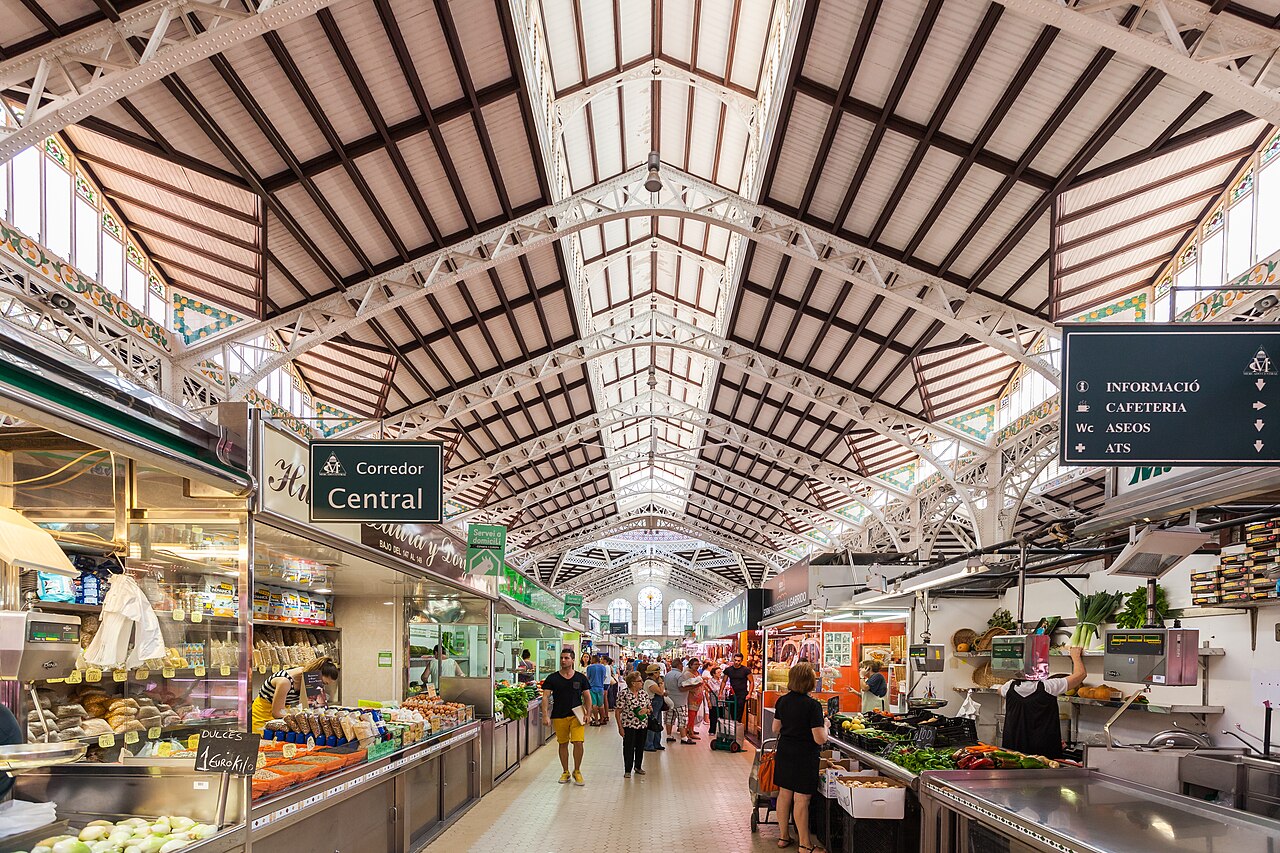

For a small, purposeful browse, look for the fruit and vegetable counters, rice and dried goods, then the stalls selling olives or preserved foods. Valencia’s surrounding farmland is closely connected with the market’s identity. Not every stall will have the same produce, and there is no need to buy anything to enjoy the architecture. If you do shop, a small, easy-to-carry purchase is more practical than a heavy bag for the next stop.
Allow around 40–45 minutes for this selective visit. The official market directory can help you locate categories of stalls before you arrive. Give people room to shop and ask before touching produce or photographing individual counters; this is a working market, not a display arranged for visitors.
Choose the right market door
The market has entrances on several streets. For a convenient approach, search for Plaça de la Ciutat de Bruges; for help from staff, the operator places its customer-service point at the Avinguda de l’Oest entrance. Valencia City Council identifies adapted ramps at Plaça de la Ciutat de Bruges, Carrer de la Vella de la Palla, Avinguda de l’Oest (also called Barón de Cárcer) and Carrer de Palafox. Published ramp gradients range from 3% to 7%, and the council lists five adapted lifts inside. Before leaving the market for La Lonja, look for the Plaça del Mercat side, which faces the old trading hall.
If toilets are important, ask at customer service when you arrive. The market lists basement services, but the council’s wording about a basement accessible toilet is not proof that one is operating today. Ask whether the facility you need is currently open and how to reach it. Market information: +34 963 829 100. The market also has a café inside, though this does not guarantee a free chair when you need one.
10.20 am | Meet Valencia’s medieval merchants
From the market’s Plaça del Mercat side, look across the square towards La Lonja. The proximity of these two buildings is part of the pleasure: their façades face the same marketplace, yet they speak of different centuries. The monument’s visitor entrance is listed at Carrer de la Llotja, 2; follow the entrance signs rather than assuming every historic doorway is in use.
Inside the Sala de Contratación, eight slender spiral columns carry the Gothic vaulting, drawing your eye upwards. The hall was built for merchants and financial dealings, not for a royal court. Work began in 1483, and La Lonja was recognised by UNESCO in 1996. On the market-facing façade, see whether you can pick out the high Renaissance gallery and its carved portrait medallions: Valencia’s cultural service counts forty of them.
If the entrance is manageable, allow 30–45 minutes for the Trading Hall and, if convenient, the orange-tree courtyard. The upper rooms and tower are not necessary for this itinerary. For a good exterior view of the façade details, Valencia’s cultural guide suggests standing opposite the monument near the Church of Santos Juanes.
Check the entrance steps before paying
The municipal accessibility sheet describes seven 20 cm steps at the main entrance, a heavy manual door, 23 more steps to the upper floor and no internal lift or accessible toilet. It also records an 8 cm step into the orange-tree courtyard. A separate specialist guided-tour listing has mentioned a platform lift at an alternative entrance, but its availability to independent visitors is unconfirmed. If step-free entry is essential, check with La Lonja directly before travelling: +34 962 084 153 or lonja@valencia.es. Do not assume the alternative entrance will be available.
The exterior is a satisfying stop in its own right. Take time with the stonework, the height of the building and its position opposite the busy twentieth-century market. If the steps are unsuitable, make that your La Lonja visit and move on to a seat.
11.10 am | A Valencian pause at Horchatería de Santa Catalina
After La Lonja, make your way towards Plaça de Santa Catalina, passing through the pedestrian streets of the old town. Plaça del Doctor Collado and Plaça de Lope de Vega are useful names to orient yourself on the way. You are close to Plaza Redonda, but save the square itself for the optional extension. Allow 25–35 minutes for a proper sit-down break rather than squeezing a drink into the next queue.
Horchatería de Santa Catalina is at Plaça de Santa Catalina 6, beside the church. Its own website lists opening hours of 8.15 am–9.30 pm every day and gives +34 963 912 379 as its telephone number. These hours make an 11.10 am visit a realistic plan from Monday to Saturday. It is a popular establishment, however: an open café does not guarantee an available table, a quiet atmosphere or a suitable toilet. Check the current hours, seating arrangements and any step-free access you need before depending on them.
Here you can order horchata de chufa, Valencia’s sweet tiger-nut drink, traditionally paired with long, soft fartons. The horchatería also advertises hot chocolate with churros and coffee, so there is no need to choose something unfamiliar. A seated break and a taste of local food make a better midpoint to the morning than another hurried monument.
The shorter morning finishes after your drink. If the horchatería is busy, ask about the wait or choose another open café with a seat; do not keep walking in search of a supposedly guaranteed table. From Plaça de Santa Catalina, check the location of your actual return bus stop or permitted taxi pickup before deciding whether to continue.
11.45 am | Optional extra: Plaza Redonda
If you still feel like exploring, return towards Plaza Redonda from Plaça de Santa Catalina. The square has level entrances on Carrer de la Pescateria and Plaça de Lope de Vega, according to Valencia City Council. Choose whichever pedestrian approach suits your onward route. A level entrance to the square does not certify the kerbs or surfaces on the streets leading to it.
The surprise is the shape. Built in 1840 to a design by Salvador Escrig, Plaza Redonda is a small circular space about 37 metres across, with balconies and shops around a central fountain. It occupies the site of an earlier slaughterhouse and recalls Valencia’s traditions of small-scale retail. Browse the textiles, embroidery and craft shops if they are open, then look up towards Santa Catalina’s bell tower. On the paving, you may spot a reference to Vicente Blasco Ibáñez’s novel Arroz y Tartana.
Twenty to thirty minutes is enough for a relaxed look without making promises about how many shops will be trading. The city describes an accessible circulation route around the square, although there is a 12 cm step at the fountain. Leave the square by the approach that best suits your onward transport, and do not add the bell-tower climb to this gentle morning.
Two versions, with a sensible way home
Shorter version | Market + La Lonja + a horchata break
Start in Mercado Central, cross Plaça del Mercat to the marked La Lonja visitor entrance, and finish at Horchatería de Santa Catalina, Plaça de Santa Catalina 6. Aim for 9.30–11.45 am, allowing extra time if you queue at La Lonja or prefer a slower market browse. If the entrance steps are not suitable, enjoy La Lonja from outside and keep the seated break.
Longer version | Add the circular square
After your break at Santa Catalina, continue to Plaza Redonda via a pedestrian approach towards Plaça de Lope de Vega or Carrer de la Pescateria. Allow another 20–30 minutes, finishing at approximately 12.15–12.30 pm. The extra stop is especially convenient if it also leaves you near the route to your return transport.
Walking and standing: the difference that matters
The market and La Lonja face the same square, but the distance on foot depends on which doors you use. Leave the market on its Plaça del Mercat side and follow the signs to La Lonja’s visitor entrance at Carrer de la Llotja 2. Afterwards, head through the pedestrian streets towards Plaça del Doctor Collado and Plaça de Santa Catalina 6 for your café break. If you choose the longer version, Plaza Redonda is close to Santa Catalina, with entrances at Plaça de Lope de Vega and Carrer de la Pescateria. Check walking directions for your selected entrances and return stop before setting out. There is no reliably measured total for either itinerary, and any map estimate will not include the distance walked inside the market or time spent standing at the monuments.
Tickets, public transport and useful small details
Mercado Central: Monday–Saturday, 7.30 am–3.00 pm, free entry; no normal market trading on Sundays or public holidays. La Lonja: Monday–Saturday, 10.00 am–7.00 pm (last admission generally 30 minutes before closing), Sundays and public holidays, 10.00 am–2.00 pm. The city lists closures on 1 and 6 January, 1 May and 25 December, with possible special changes. Standard admission €2; concession €1 for eligible visitors; free admission on Sundays and public holidays. Being over 50 alone does not establish concession eligibility. Plaza Redonda is a free public square; individual stalls and shops follow their own hours.
The Valencia Tourist Card may include admission to La Lonja, but compare its total price with your actual plans. Buying a card simply to avoid a €2 entrance fee rarely makes financial sense. There is no fixed café budget in this itinerary: what you pay depends on the drink or food you order, and current menu prices should be checked on the day.
EMT buses serve the market area, particularly around Avinguda de l’Oest. EMT route notices identify Mercat Central–Beata (stop 2288, associated with line 7 in the notice) and Avinguda de l’Oest–Hospital (stops 2290/1 and 2290/2, associated with lines 27 and 7 respectively in the notice). These are reference points, not a promise that a particular service suits your hotel or is operating unchanged on your travel date. Check the current EMT Valencia journey planner for your outward and return journeys, direction of travel and boarding stop. A metro station may be farther on foot than a convenient bus.
A taxi can be worthwhile if you want to save energy for the sights. Agree on a permitted pickup or drop-off near the market or Plaça de Santa Catalina rather than expecting access through pedestrian lanes. Wear shoes suitable for old paving, carry drinking water in warm weather, and remember that the Fallas period in March brings temporary closures, changes to transport and heavy crowds. Check EMT notices shortly before travelling.
Three ways to make the morning work on a difficult day
If rain makes the paving slippery, enjoy more of the covered market and consider La Lonja from outside rather than tackling uncomfortable entrance steps. On a busy morning, visit fewer market aisles and take your café break earlier; Santa Catalina opens well before the market’s proposed 9.30 am start. If the seating or toilet arrangements you need are unavailable, adapt the plan rather than adding an unplanned search through the old town. The optional square can wait for another day.
A little more Valencia, if you decide to stay longer
This small neighbourhood offers a useful glimpse of ordinary Valencia: a place to buy ingredients, an historic square to cross and somewhere to sit over a drink. If you were staying for several weeks, the more important question would be how easily you could repeat the everyday part — from your accommodation, with shopping in hand, on a hot afternoon.
My Spain 50+ Travel Guide goes beyond this compact city walk. It compares Valencia, Costa Blanca and Costa del Sol and helps readers consider where to stay, how to get about and what a longer visit may cost. If this market morning makes you curious about spending more time in the region, the guide is a practical next step. You do not need it to follow the walk above.
Later, it may be the market’s lofty roof you remember. Or the light climbing La Lonja’s spiral columns. Or a small round square that seemed to appear almost by accident. Three very different sides of Valencia, discovered in the space of one morning.